
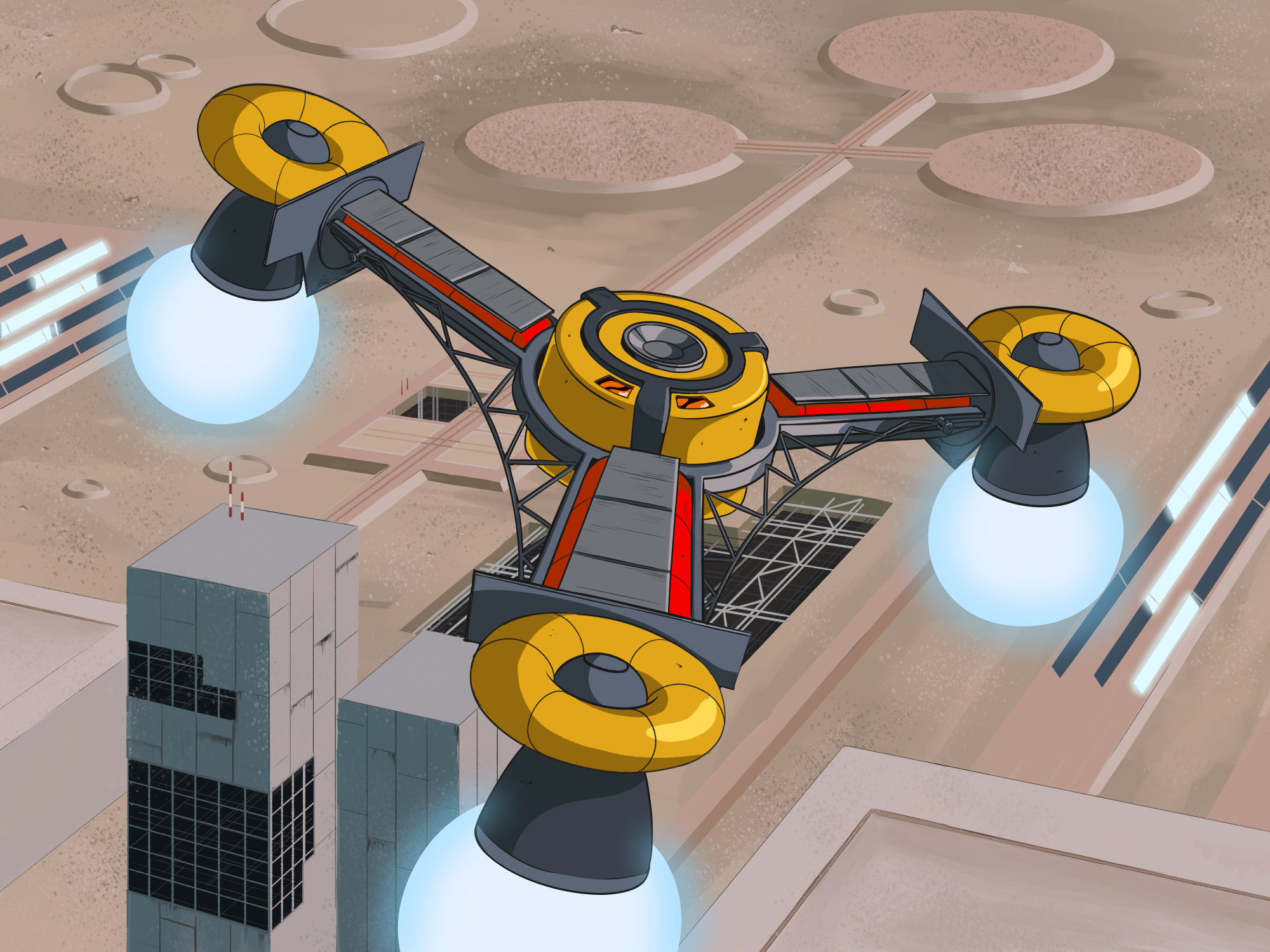
A widely used medium range star-ship aimed at the civilian/industrial market, the Caelus Breeze is designed for hauling large, heavy, objects. Its design allows it to easily tow heavy objects into new orbits, which would have lots of application in mining, salvage, and repair work. Originally produced in Jovian orbits, the craft has been produced under license throughout human space.
Overview
Class: Caelus Breeze
Operators: Private Operators, ISOC, The Magnetic Assembly
Manufacturer/Product Name:
- Caelus | Caelus Beeze
- The Magnetic Assembly | Aceeveex3
- Atlantica Electromotive | Caelus Gusto
Introduced: 2320
Height: 24m
Diameter: 140m
Crew: 4
Propulsion:
x3 Caelus Impulse Compact Fusion Drive
Maximum Acceleration: 0.6g
Range: ~3 months before resupply
Avionics:
2x Caelus Containerized Avionics Cores
Communications:
4x Stellar inter-orbit radio
Sensors:
10x Stellar Electro-Optical Sensor
1x Stellar Long Range Radar System
Armament:
1x Caleus Grapple Launcher
History
The Jovian gravity well had grown to be one of the major economic centers outside of earth by the 2300s. An abundance of fusion fuels from Jupiter and raw materials from the asteroid belt fueled a huge boom in industry.
Caleus market research would identify the difficulty in moving asteroids early on. Often times specialty rigs would need to be setup in order to move an asteroid which required excessive time and effort.
The resulting engineering solution was to use techniques from early interstellar ship designs, placing the engines at the 'top' of the ship, and angling the various nozzles to create a safe space directly under the ship where a payload could be stored. Crews could easily wrap an asteroid in foil, then simply pull the entire weight behind the ship.
Caleus would sell the design to private operators around Jupiter. Because the company used lots of off the shelf components and older fusion drive systems, the design was easy to license out, allowing other manufacturers to produce it in other star systems. By 2326, both legal and unlicensed versions of the craft could be found throughout human space.
Caleus market research would identify the difficulty in moving asteroids early on. Often times specialty rigs would need to be setup in order to move an asteroid which required excessive time and effort.
The resulting engineering solution was to use techniques from early interstellar ship designs, placing the engines at the 'top' of the ship, and angling the various nozzles to create a safe space directly under the ship where a payload could be stored. Crews could easily wrap an asteroid in foil, then simply pull the entire weight behind the ship.
Caleus would sell the design to private operators around Jupiter. Because the company used lots of off the shelf components and older fusion drive systems, the design was easy to license out, allowing other manufacturers to produce it in other star systems. By 2326, both legal and unlicensed versions of the craft could be found throughout human space.
Layout

The Breeze uses radial trisymetry where each arm houses an engine and fuel tank that is connected to the crew module in the center of the craft. The bottom of the craft houses a grapple cannon while the top has additional space to attach additional fuel tanks for long running operations.
Armor
The breeze is armored against micro meteor impacts from all aspects, and has additional armoring against impacts along the underside of the craft to help mitigate the dangers of towing large objects that might break apart in transit.
Crew Area
The crew area of the ship is made up of two modules stacked on top of each other. The upper level houses personal crew space and control systems while the lower level houses airlocks, work equipment, and additional storage space.
Fuel Tanks
Fuel for normal operations are stored in takes in the craft's arms. Additional fuel tanks can be stacked ontop of the crew module which can make it more difficult to precisely maneuver the ship, but can extend the range of the ship to allow it to pull heavy objects into new orbits.

Breeze hauling an asteroid
Breeze hauling an asteroid