• Nobles of Null is a forum based roleplay site where sci-fi and magic collide. Here, Earth remains fractured and divided despite humanity reaching out to the stars. Worse still, the trans-human slaves of one major power have escaped, only to establish their own Empire, seething with resentment at abuses of the past. Even the discovery of aliens, though medieval in development, has failed to rally these squabbling children of Earth together with its far darker implications. Worse still, is the discovery of the impossible - magic. Practiced by the alien locals, nearly depleted and therefore rare, its reality warping abilities remains abstract and distant to the general populace. All the while, unseen in the darkness of space, forces from without threaten to press in. For those with eyes opened by insight, it is clear that an era is about to end, and that a new age will dawn.

Space and Low Gravity Body Habitat Daily Life

Ray of Meep

Administrator
Wiki Moderator
Early space habitats, and hastily constructed ones, will involve habitat tubes built into dug out mines on moons and asteroids, which provide natural structures and radiation shielding. These tube habitats have no artificial gravity, cramped corridors, limited living space in general. Residents require extensive medical attention, constant exercise, and mental therapy to stay healthy. Depending on the size of the colony, the tube habitats can be independent with careful resource management, local hydroponics, and in-situ resource utilization. However, such colonies are often too small, the bodies they're built into without the sufficient element diversity, to be sufficiently deemed independent.

Life in tube habitats is extremely militaristic and spartan, by necessity and tradition; the first colonists of tube habitats would've found their homes in lava tubes on Luna, trained by Earth government militaries. Most of these colonists would've had experience in Earth navies and air forces. Children from a young age would be taught to preserve every drop of water and crumb of protein, well educated in maintaining life support systems. Privacy is essentially non-existent, both by necessity for survival and due to close proximity to one another everyday. Thus, within a few generations, a tube colony becomes highly conformist and utilitarian, prone to dictatorships. Xenophobia, especially towards comparatively wasteful planet-borne, is common. Tube colonists in general face higher rates of anxiety and anger issues. In extreme cases of ableism, infanticide is deemed a necessary evil to maximize productivity and minimize resource waste. Social isolation of tube colonies can also lead to rise of various fanatical cults that consume entire communities, growing more often over the centuries as the major governments lose track of small colonies. Life in tube habitats is harsh, but those born into it can become some of the most technically competent, disciplined and tough members of society humanity has seen, provided they have healthy outlooks on life.
 
Space habitation brings many limitations, all the way down to basic food consumption. Soups and dishes with free flowing sauces (enchiladas, mashed potatoes with gravy on top) are restricted, along with crumby foods such as tacos, due to their tendency to create free floating solid and liquid particles that can reach life support systems and sensitive electronics, causing unnecessary damage. Cooking methods are also restricted as the ingredients must be placed in a sealed chamber that prevents steam and grease reaching the rest of the habitat.

The restrictions of ingredients and methods results in certain dishes becoming widely popular. The bare minimum of a "cuisine" is a heated tube of paste akin to peanut butter, made from rice, mushrooms, and beans for core carbs, fat, and protein, with vegetable extract for vitamins and minerals. More palatable are soft congealed foods that can hold their own shape: burritos, rice balls, etc. Crickets and meal worms are common sources of animal protein, commonly seen as paste. More developed tube colonies have access to filter feeding crustaceans and fish, or even vat grown beef, pork, and chicken, providing the colonists proper animal protein.
 
1631978423159.png
1631978451766.png
1631978480398.png

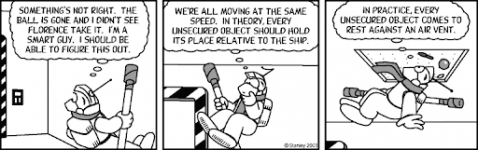
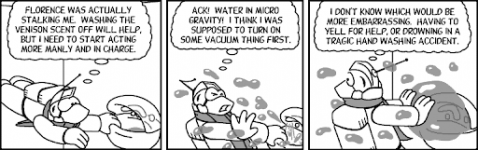
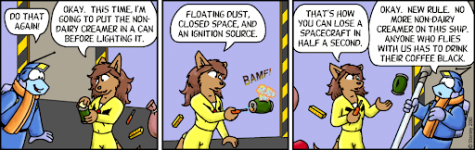
For those that don't know, Freefall is one of the greats. Its a mostly hard sci-fi webcomic following Sam Starfall's adventures with his robot friend and a genetically engineered wolf named Florance that they 'pick up' along the way.


---


Fermination IN SPACE:
Interplanetary Gastronomy: https://www.media.mit.edu/projects/Interplanetary-Gastronomy/overview/

---

A few more things to think about: Meat and other animal products would be more rare due to the difficulty of production in space. People might be Vegan by necessity

Cooking would be more difficult in space, since there is no gravity and heat convection works differently. You might need a special oven in Zero-G to get things to cook right (Or just use a microwave)

Certain other things might be more difficult to get ahold of because farms would be Zero-G or less than 1 G. IT seems that vegetables are easy to grow and there is already a vegetable garden on the ISS.

Also flavor works different in space. Already you see Astronauts bringing more spicy foods/flavorings into space with them. Flavor additives might be very common, especially if they are somewhat sticky like jellies to help hold things together.
 
Further thoughts:

Packaging will be an interesting question.

Do you use some extraordinarily thin packaging that's as lightweight as possible that you throw out when you're finished?

Do you use edible packaging like rice paper?

Do you use heavier packaging that you can recycle?
 
Spices and flavoring will necessarily have to come in the form of sauces. Powders such as salt and pepper will prove disastrous for life support systems and sensitive electronics.

Microwaves are the best bet, I agree. For better cooking like ovens, special dedicated, reusable filters will have to be used. Centrifuges can be used for particulate management.

Rice paper seems to be the way to go with packaging.
 
For entertainment, video games, virtual reality will be vital to provided a resemblance of planetary living experience to tube colonists, a core part of their mental health. Just as we play video games for release and to experience fantastical settings, colonists will play video games to experience environments beyond their cramped corridors. Driving simulators and in-atmosphere flight simulators are popular, though they could also potentially be nauseating to a people with no real sense of what a horizon is, or the lack of a ceiling. Placing the point of view within a small compartment might alleviate these concerns. First person mech and tank games have real potential.

Sports are difficult due to the lack of space. A variation of table tennis could be popular, though it'll likely simply be referred to as tennis as two players simply bat a ball back and forth at each other in a corridor with rules for hitting the walls. Long endurance running and cycling in place on machines, along with resistance pulling (weight lifting in space) are likely popular participation sports, but they'd be vital physical exercise anyways.
 
Top